Summary: massage can help a sore back and a lot of what people call sciatica, as long as the pain is coming from muscle rather than from the spine itself. UK guidance says manual therapy, massage included, earns its place only alongside movement, so that is how I use it. If your pain is in both legs, if you have numbness around your bottom or genitals, or if your bladder or bowel has changed, stop reading and call 999, because that is not a massage problem. Everything else, read on.
Most weeks someone sits on the edge of my couch and says “I’ve got sciatica.” Sometimes a GP has said the word. More often a search engine has. What they have is a pain that starts around one buttock, runs down the back of the thigh, and has gone on long enough that they walk differently.
Some of those people I can help a great deal. Some I can help a little, as one part of a plan a physiotherapist is running. A few I send straight back to their GP, because what they describe is not something a massage therapist should touch. All three groups open with the same line, so this is the article I wish I could hand over before the first appointment. I have used the sports massage and deep tissue massage techniques described here on a great many lower backs, and I have also learned, sometimes the hard way, when to keep my hands off one. Every clinical statement below comes from the NHS, NICE, the Cochrane Library, the Chartered Society of Physiotherapy or a peer-reviewed clinical reference, named each time. Where the evidence for massage is thin, I say so, because you should know that before you pay me.
Sciatica is a symptom, not a diagnosis
The word tells you where it hurts, not why. Sciatica, as the NHS describes it, happens when the sciatic nerve, which runs from your lower back to your feet, is irritated or compressed. The symptoms usually affect the bottom and back of one leg: burning pain, tingling, numbness or weakness.
Notice what that definition leaves out: what is pressing on the nerve. That is the question that decides whether I am the right person to see. The NHS lists the usual causes: a slipped disc, which it calls the most common; spinal stenosis, a narrowing of the channel the nerves pass through; spondylolisthesis, where one bone of the spine slips forward on another; and a back injury. All four happen at the spine. None is a muscle. A massage therapist, however good, cannot push a disc back into place or widen a spinal canal, and anyone who says otherwise is selling something.
The better news in the same NHS text is that sciatica usually settles in a few weeks to a few months, and the things that help most are cheap: carry on with your normal activities, start gentle movement early, use heat on the painful area, and avoid long spells of sitting or lying down. Massage is good at making that list possible.
The two leg pains that look the same and are not
Pain running from the buttock down the back of the leg has two common origins, and only one is in the spine. The first is the one above: a disc, a narrowing or a slipped vertebra pressing on a nerve root as it leaves the spinal column. The second sits lower and further out. Once the sciatic nerve has left the spine it passes through the buttock, underneath or sometimes straight through a small muscle called the piriformis. When that muscle and its neighbours are tight, overworked or in spasm, they can irritate the nerve there instead.
Clinicians call the second one piriformis syndrome. The clinical reference on piriformis syndrome in the National Library of Medicine’s StatPearls series describes it as sciatic nerve entrapment in the buttock rather than at the spine, and puts it at between 0.3 and 6 per cent of all low back pain and sciatica, a wide range because it is a diagnosis of exclusion. The presentation it describes, buttock pain that may shoot, burn or ache down the leg, worse with hip movement, impossible to sit through, will be familiar to many of my clients.
I am not telling you your sciatica is “really” a tight muscle; statistically it is more likely to be a disc. I am telling you that the buttock-origin version exists, that it is the version hands-on work is suited to, and that the spine-origin version is not, so working out which you have is worth twenty minutes of anyone’s time.
That table is a guide for a conversation, not a diagnostic test, and neither column is “safe”. Mostly left, and massage has a real job to do. Mostly right, and I can help you stay comfortable and moving, but I am not your main treatment and I will say so.
What the evidence says massage does for a bad back
I would rather you heard this from me than found it afterwards.
UK guidance treats massage as a supporting act, not the headliner. The National Institute for Health and Care Excellence, in its guideline on low back pain and sciatica, says clinicians should consider manual therapy, which it defines as spinal manipulation, mobilisation or soft tissue techniques such as massage, but only as part of a treatment package that includes exercise. Massage on its own, with nothing changing in the rest of your week, is not what the guideline recommends. The same guideline says not to offer belts, corsets, traction, acupuncture, ultrasound or TENS for back pain, and not to routinely send people for scans outside a specialist setting.
Then there is the Cochrane Library. Its review of massage for low back pain, covering 25 trials and 3,096 people, found that for sub-acute and long-standing back pain massage beat doing nothing for pain and function in the short term but not at long-term follow-up, and against other active treatments reduced pain with no difference in function. The authors rated the certainty low or very low, because the studies were small and imperfect, and concluded that they had very little confidence that massage is an effective treatment for low back pain.
Massage may make your back feel better in the short term, but the evidence is low or very low certainty and does not show a lasting benefit. What changes the course is the thing the NHS, NICE and the physiotherapists agree on: moving more, sooner, with less fear.
The same review answers the question people are too polite to ask: across all 25 trials there were no serious adverse events, and the most common side effect was a temporary increase in pain, reported by between 1.5 and 25 per cent of participants depending on the trial.
So why book a massage at all? Because the hour on my table is an easy hour in which to get a frightened, guarded back to let go, and the twenty minutes after it, when you stand up and move without bracing, is where the real work starts. The massage opens the door. You walk through it.
Where massage earns its keep
The Chartered Society of Physiotherapy published a list called 10 things you need to know about your back, and I point clients to it because it says in ten lines what I say in ten minutes. Your back is stronger than you may think. You rarely need a scan. Avoid bed rest. You should not fear bending or lifting. You can have back pain without any damage or injury. The CSP adds that back pain is very common and rarely dangerous, and that in 98 per cent of cases, according to the research it cites, people recover reasonably quickly, many without treatment.
Notice how many of those are about fear. A back held rigid for weeks out of fear gets tight, weak and more painful, and a person in that state cannot do the one thing that would help, which is move normally. That is the gap massage fills. In plain terms, for a muscular back and a buttock-origin leg pain I can:
- Reduce the guarding. Slow, deep work through the gluteals, the piriformis and the muscles either side of the spine lowers the resting tension that keeps a back braced. Some people notice they stand up taller afterwards; others notice little.
- Find the actual tender point. Most people with buttock-origin leg pain have one spot that reproduces their symptom when pressed. Finding it and working it with sustained pressure is often the moment the client says “that’s it, that’s the pain”.
- Improve how the hip moves. A hip that will not extend or rotate properly asks the back to do its job. Stretching through the hip flexors, glutes and hamstrings gives it a rest.
- Support movement. The aim is to help you feel more comfortable as you return to movement, but I cannot promise how you will feel when the session ends.
What I cannot do is take pressure off a nerve root at the spine. If a disc is the problem, I can stop the muscles around it making everything worse, but the disc settles in its own time, with movement, or it does not, and then you need a doctor.
What a session for sciatic-type pain looks like at my clinic
My guide to massage in Welling covers the general shape of a first appointment, a conversation, an assessment, then treatment. For a back and leg pain the balance shifts towards the first two.
The first fifteen minutes are questions and watching you move. I run through the table above, ask about pins and needles, numbness and weakness, and ask the uncomfortable questions about bladder, bowel and numbness around the saddle area, because those answers decide whether the session happens at all. Then I watch you bend forward, bend back, squat, and lie down and get up again.
Then you lie face down, covered with towels and undressed only as far as you are comfortable. I start broader and slower than most people expect, through the whole lower back, both buttocks and both legs, because a guarding body does not let a stranger straight into the sore spot. Only once the tissue has settled do I go looking for the specific point in the buttock, and when I find it, I hold it.
That part is uncomfortable, within reason. Sustained pressure on a tight piriformis often sends a dull version of your familiar pain down the leg, and after thirty seconds or so it fades. That is the response I want. Sharp, electric or spreading pain is not, and if that is what you feel I stop, because that is a nerve telling us both something.
This is the kind of position and pressure involved when working through the back of the leg and hip.

After the deep work comes the stretching, taking the hip through rotation and flexion while you breathe out, which is where some people notice a difference. Then you get up and we repeat one of the movements from the start. If it is easier, we know what to do next time. If it is no different, I tell you, and we talk about whether a physiotherapist or your GP is the better next call.
What I tell people to expect is uncertain: responses vary, and the evidence does not allow me to predict whether you will feel looser, unchanged or temporarily sorer after a session. You also leave with homework of no more than two or three short things, because long exercise sheets go in a drawer.
A 60-minute session is £50 and a 90-minute session is £80, and for a first visit with this problem I would book the longer one, because the assessment eats into the hour. The full list is on the pricing page. Deep tissue massage is one booking option, but I will not know whether it is appropriate until I have reviewed your symptoms and any advice from your GP or physiotherapist.
The things that make it worse, including two that feel like they should help
Sitting still. The NHS advice is to avoid long periods of sitting or lying down, and it is the advice people find hardest because sitting feels safe. A buttock-origin pain hates a chair: the piriformis is being sat on, and the longer you sit the tighter it gets. The short version of the piece I wrote on desk workers who train at weekends is: stand up every half hour, whether or not you feel you need to.
Resting until it goes away. The first of the two that feel like they should help. Bed rest was standard advice a generation ago; the CSP now says the opposite in as many words, because a back rested for a fortnight has lost strength and gained fear.
Stretching it hard. The second one. People find a stretch online, feel it pull on the painful spot, and assume more is better. If the pain is from a tight muscle, a gentle stretch held comfortably is useful. If it is from an irritated nerve, yanking it tighter with an aggressive hamstring stretch makes it angrier. A stretch should feel like a stretch, not like your symptom. If it reproduces the leg pain, back off.
Guarding. Holding the back rigid, bracing before every movement, moving as if something might break. In my experience it is what keeps people stuck. The CSP’s point that you can have back pain without any damage or injury is the one I repeat most, because once someone believes it they move normally again, and moving normally is the treatment.
Chasing it with a scan. NICE says not to routinely offer imaging outside a specialist setting, and the CSP says a scan can do more harm than good: it finds things that may have been there for years, and then you are frightened of a picture.
When massage is the wrong call today
I would rather lose a booking than treat someone who needs a doctor. These come straight from the NHS sciatica guidance and they are not mine to soften.
Go to A&E or call 999 if you:
- have sciatica on both sides at once
- have weakness or numbness in both legs that is severe or getting worse
- have numbness around or under your genitals, or around your bottom
- find it hard to start peeing, cannot pee, or cannot control when you pee, and this is not normal for you
- do not notice when you need to poo, or cannot control when you poo, and this is not normal for you
Those symptoms can mean pressure on the bundle of nerves at the base of the spine, and it is a same-day problem.
See a GP, rather than me, first if the pain has not improved after a few weeks of looking after it yourself, is getting worse, or is stopping your normal activities.
The NHS guidance on back pain adds a second list, and I follow it. Ask for an urgent GP appointment or call 111 if you have back pain and feel hot, cold, shivery or generally unwell, or if it is severe pain that started suddenly or is getting worse quickly. Call 999 or go to A&E if the pain started after a serious accident, such as a car accident, or if you have chest pain with it. Those are questions for someone with a medical degree before they are questions for someone with a massage table.
A good massage therapist should notice when you need someone else. I have my hands on a lot of backs every week, and the ones that do not feel right stand out. When I send you on, it is because I can tell the difference.
What clients with back pain have told me, in their words
These are quoted from the reviews on my About page, first names only, because I do not invent testimonials.
Luke had been struggling with ankle and lower back pain for around five years and had recently started rehabilitation exercises. He wrote that after his very first massage he could stand up from a seated position without discomfort for the first time in a very long time. One session did not fix five years of pain. It gave him a window in which movement was easy, and he was already doing the exercises that would use it. That is what massage does well.
Robert’s review says I took the time to learn about his spine and ribcage and adapted the massage accordingly, and that his back feels better than it has done for ages. The word I am proudest of there is “adapted”. There is no routine for a bad back, only the back in front of me.
Between sessions: the two-minute habits that do more than the massage
If you only do one thing, walk. Not a programme, not a step target. A walking body moves its hips and back through a small, safe range hundreds of times, and for a sore back it is the habit I would keep before any other. Beyond that, the list is short and drawn from these:
- Stand up every half hour. Set an alarm. Thirty seconds on your feet, a gentle lean back, sit down again. For buttock-origin pain this alone changes the day.
- Heat, not ice. The NHS advice for sciatica is heat packs on the painful area, and in my experience a wheat bag on the buttock before bed does more for the piriformis than any stretch.
- One gentle hip stretch, held comfortably. Which one depends on what we found on the couch. Thirty seconds, breathing, never into the leg pain.
- A pillow between your knees in bed. It takes the twist out of the lower back and the stretch off the nerve.
For some clients I add kinesiology taping across the lower back or glute at the end of a session, a sense of support for a few days while they rebuild confidence in moving. It is not a treatment in itself, and I say so, but it is a useful bridge for a nervous back.
About a third of my clients come from outside Welling. If getting to the clinic is the problem, I do home visits up to 30 kilometres from Welling, with a travel fee possible for longer distances. Get in touch and tell me where you are.
“But what about…” Your questions, answered honestly
“Can massage cure sciatica?”
No, and anyone who says yes is not reading the evidence. Massage can reduce the pain and the guarding around a sciatic-type pain, and when the cause is the buttock muscles rather than the spine it is where hands-on work can help. The NHS says most sciatica settles in weeks to months on its own; massage is a way of being more comfortable and mobile while that happens, and of stopping the muscles turning a six-week problem into a six-month one.
“Is deep tissue massage safe if I have a slipped disc?”
Massage does not touch the disc, and the Cochrane review found no serious adverse events across 25 trials. What is not safe is deep pressure directly over an acutely irritated area, or aggressive stretching that pulls on an inflamed nerve. With a confirmed disc problem I work around the spine rather than on it, keep the stretching gentle, and want to know what your GP or physiotherapist has said before I start. With any of the red flags above, the answer is no until a doctor has seen you.
“How many sessions will I need?”
I cannot promise a number and I distrust anyone who does. One session to assess and treat, then an honest conversation about whether it helped. If it did, we decide together whether a second session is worth booking. If two sessions have changed nothing, more massage is not the answer, and I will point you to a physiotherapist or your GP.
“Should I see a physio or a massage therapist first?”
If you have numbness, weakness or pins and needles reaching your foot, or the pain started with a specific injury, see a physiotherapist or GP first. If the pain is mostly buttock and thigh, worse with sitting, with none of the warning signs, massage is a reasonable first step, and I will still say if what I find suggests you need the physio. NICE wants manual therapy delivered alongside exercise, and a physiotherapist designs the exercise.
A last word before you book
If you take one thing from this, make it the CSP’s line that you can have back pain without any damage or injury. Most people who walk into my clinic braced and frightened walk out moving more freely, not because I fixed anything, but because someone worked on the muscles until they let go and then showed them that bending did not break them.
That is what massage is for here. Not a cure, not a replacement for a physiotherapist or a GP when you need one, and not magic: a reliable way of getting a guarded body to move again, and movement is the treatment.
See you at the clinic,
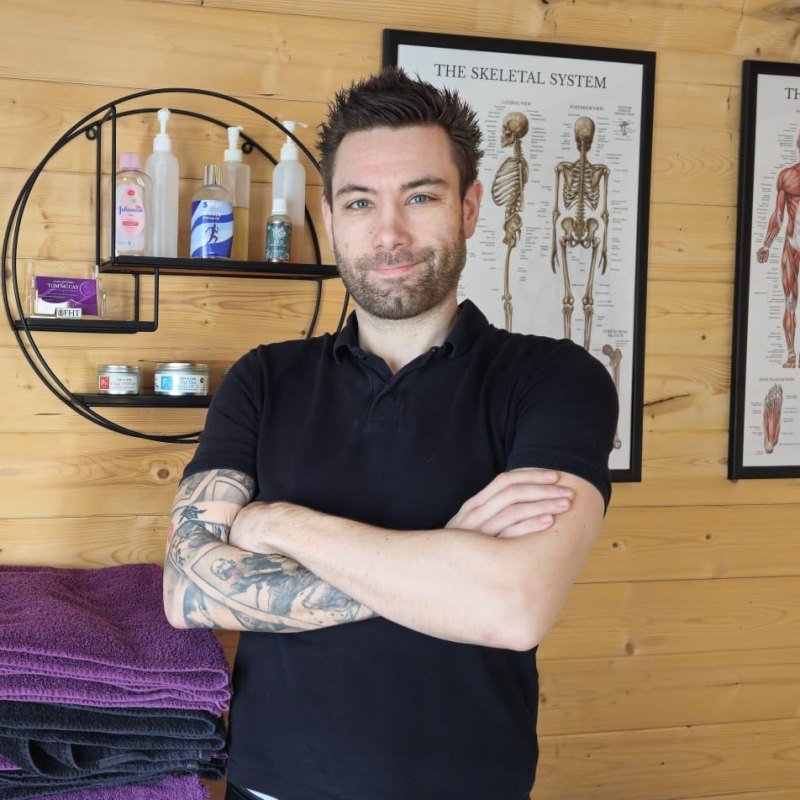
Tom McCay, Level 5 Sports Massage Therapist, Massage Works, 15 St Michaels Road, Welling DA16 2AH. The training behind the title is on the about page.
If you want to discuss whether massage may be appropriate for you, book a first session and bring your questions.